
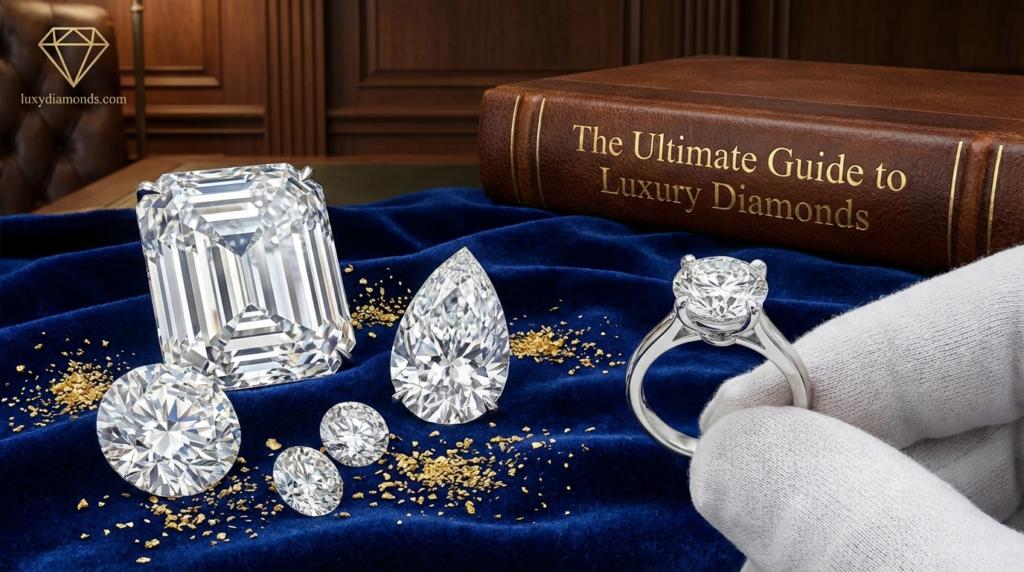
For centuries, the diamond has stood as the ultimate symbol of permanence, power, and incomparable beauty. While many diamonds possess brilliance, true luxury diamonds occupy a category all their own—a rarefied echelon defined not just by size, but by unparalleled rarity, meticulous provenance, and master craftsmanship. If you are pursuing an heirloom, a statement piece, or a tangible asset, understanding what elevates a magnificent stone into a luxury legacy is essential. Step beyond the basics of the 4Cs and delve into the world of extraordinary brilliance.
Defining True Luxury: Beyond the Standard 4Cs
Every diamond is graded on the four traditional Cs: Cut, Color, Clarity, and Carat weight. However, stones that achieve true luxury status often exceed the highest conventional grades and adhere to an unofficial, higher set of criteria. These stones are exceptional, often representing the top 0.001% of all mined diamonds globally.
The Pursuit of Perfection: D Flawless and Type IIa Diamonds
In the luxury market, the standard for color often begins at the D grade (colorless), moving into the realms of Internally Flawless (IF) or Flawless (FL) clarity. Even more exclusive are Type IIa diamonds, which contain virtually no nitrogen impurities. These stones, representing less than 2% of gem-quality diamonds, are chemically purer and often display superior optical transparency and fire. Historically, the legendary Golconda diamonds were Type IIa, making this classification synonymous with ancient royalty and ultimate rarity.
The Critical Fifth ‘C’: Provenance and Ethical Sourcing
Luxury buyers demand assurance that their stone is ethically and sustainably sourced. The concept of provenance—the history and traceable origin of a diamond—becomes a critical fifth ‘C’. A luxury diamond should be accompanied by detailed documentation assuring its journey from mine to market. Leading jewelry houses invest heavily in traceability programs, ensuring that the emotional and financial value of the diamond is not compromised by ethical concerns.
The Artistry of Craftsmanship and Bespoke Design
A luxury diamond is never simply dropped into a standard setting. Its magnificence must be complemented by engineering and artistry that transforms the raw components into a piece of haute joaillerie. This process often involves master jewelers, proprietary cutting techniques, and decades of institutional expertise.
Master Setting and Signature Cuts
The artistry applied to the metalwork is as crucial as the stone itself. Luxury settings are often hand-forged in platinum or high-purity gold alloys, requiring hundreds of hours of delicate work by master setters who specialize in minimizing the metal’s presence to maximize light exposure to the diamond. Furthermore, many luxury houses develop their own proprietary or “signature” cuts—geometric variations on classic shapes designed to capture light in unique, breathtaking ways that cannot be replicated by mass-market cutting.
The Bespoke Experience
For the ultimate luxury purchase, the bespoke design process is standard. Working directly with an atelier allows the collector to influence every aspect of the final piece, ensuring the design perfectly complements the singularity of the primary stone. This collaborative journey is part of the inherent value, transforming the jewelry from a transaction into a unique work of wearable art destined to become an heirloom.
Diamonds as Tangible Assets: Investment and Legacy
While mass-market diamonds are generally not treated as financial investments, certain luxury diamonds—due to their extreme rarity and high demand—are increasingly viewed as tangible wealth assets, offering diversification outside traditional stocks and real estate.
The Rise of Fancy Color Diamonds
The most compelling investment sector within the diamond market is that of Fancy Color Diamonds. Stones that exhibit vivid, saturated hues—particularly pinks, blues, and reds—are astonishingly rare and have seen significant appreciation over the last two decades. The Argyle mine closure in 2020, which produced 90% of the world’s pink diamonds, has cemented the status of high-quality pinks as ultra-rarities that command record-breaking prices at auction.
Historic and Signed Pieces
Beyond natural rarity, the collector market places enormous value on diamonds that possess a historic backstory or are set within pieces signed by famous houses (like Cartier, Tiffany, or Harry Winston). The combination of a world-class stone and documented ownership by royalty or a known figure can dramatically inflate the resale value, making these items true collectors’ commodities.
The Enduring Sparkle of Legacy
Luxury diamonds represent the pinnacle of natural creation combined with human ingenuity. They are more than just sparkling adornments; they are tangible testaments to geological time, precise craftsmanship, and unforgettable moments. Whether serving as a secure store of wealth, a piece of custom haute joaillerie, or the ultimate marker of love, these stones carry a legacy that will span generations.
When seeking to acquire a luxury diamond, remember that excellence lies not just in the carat weight, but in the story, the transparency of its origin, and the perfection of its execution. Invest time in consulting with certified gemological experts and reputable luxury houses to ensure the brilliance you acquire is truly extraordinary and everlasting.