
Loose Diamonds vs. Diamond Jewelry: The Definitive Investment Comparison
When comparing loose diamonds against diamond jewelry as investment vehicles, loose diamonds typically offer a superior financial profile due to higher liquidity, lower retail markups, and standardized valuation via certification. While finished jewelry provides the “utility dividend” of wearability, it acts primarily as a consumable luxury where the costs of labor, design, and setting metal are rarely recovered upon resale unless the piece carries significant brand heritage or antique provenance. For the pure investor seeking capital preservation and potential appreciation, certified loose stones eliminate the non-recoverable “sunk costs” associated with retail jewelry settings.
Unveiling the Real Value of Diamond Assets
The allure of diamonds as a tangible asset class has persisted for centuries, serving as a hedge against inflation and a portable store of wealth. However, the mechanism of ownership—whether you buy a stone in a sealed packet or set in a platinum ring—dramatically alters the investment’s potential return.
Many buyers mistakenly equate the retail price of a diamond ring with its inherent value. In reality, the financial journey of a loose diamond differs fundamentally from that of diamond jewelry. Understanding these structural differences is critical for protecting your capital.
Loose Diamonds vs. Diamond Jewelry Investment Summary
Before diving into the granular economics, it is essential to establish the “Verdict.” The choice between loose stones and jewelry depends entirely on whether your primary goal is financial efficiency or emotional utility.
Core Definition: Pure Asset vs. Consumable Luxury
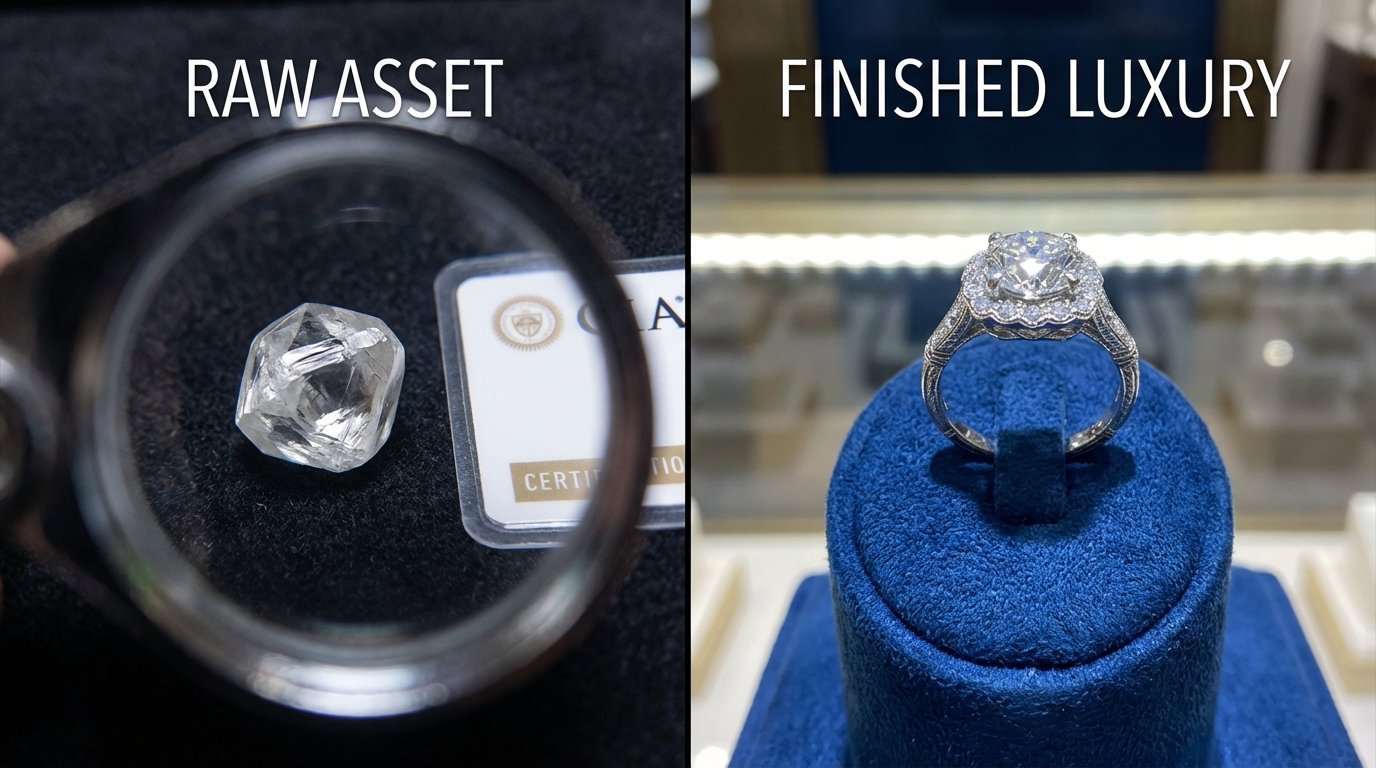
A loose diamond, specifically one that is investment-grade, functions as a commodity. Its value is derived almost exclusively from the “4 Cs” (Cut, Color, Clarity, Carat) and is validated by third-party certification (like GIA). It is a pure asset because it lacks extraneous costs that do not add to its resale value.
Conversely, diamond jewelry is a consumable luxury product. When you purchase a ring or necklace, you are paying for the diamond, plus the gold/platinum, the designer’s time, the jeweler’s overhead, marketing costs, and the manufacturing labor. Once purchased, the “newness” premium vanishes immediately, much like driving a new car off the lot.
Markup, Liquidity, and Risk Comparison
The following table highlights the financial disparities between holding loose stones and finished jewelry.
| Feature | Loose Diamonds (Certified) | Diamond Jewelry (Finished) |
|---|---|---|
| Primary Value Driver | Intrinsic quality (4 Cs) | Aesthetics, Brand, Labor |
| Initial Markup | Low to Moderate (Wholesale proximity) | High (100% – 300%+) |
| Liquidity | High (Global commodity) | Low (Subjective taste) |
| Recoverable Cost | High (Market value of stone) | Low (Scrap metal + stone only) |
| Price Transparency | High (Rapaport pricing) | Opaque (Retail subjective) |
| Investment Profile | Capital Preservation | Consumption/Utility |
The Entry Cost Analysis: Where Value is Lost
The profitability of any investment is determined the moment you buy it. In the diamond market, minimizing your cost basis is the single most important factor in future returns.
Understanding the Retail Markup Trap in Jewelry Settings
Jewelry retailers operate with significant overhead, including showroom rent, sales commissions, and inventory insurance. To cover these costs, finished jewelry carries a substantial retail markup.
When you buy a finished piece, you are effectively paying a premium for the “experience” of buying. This markup instantly puts the investor in a negative position; the asset must appreciate significantly just to break even with the initial purchase price.
Labor and Metal: Non-Recoverable Costs in Finished Jewelry
A significant portion of a jewelry piece’s price tag is labor and precious metal. While gold and platinum have intrinsic value, the craftsmanship labor is a sunk cost.
When reselling a standard diamond ring, the buyer (often a pawnbroker or jeweler) will usually pay only for the scrap value of the metal and the wholesale value of the diamond. The hours spent designing, casting, and polishing the setting are valued at zero in the secondary market.
Why Loose Diamonds Offer a Lower Cost Basis
Buying loose diamonds allows investors to bypass the “jewelry manufacturing” supply chain. By purchasing stones that are close to the wholesale level, you eliminate the markups associated with setting and branding.
Investors can acquire a stone for a price much closer to its intrinsic market value. This lower entry point means the market requires less appreciation for the investor to realize a profit upon exit.
Liquidity and Resale: The Reality of Exiting the Investment
An asset is only as valuable as your ability to sell it. Liquidity refers to how quickly and easily an asset can be converted into cash without a significant loss in value.
Fungibility Factors: Why Certified Loose Stones Sell Faster
Loose diamonds with reputable certification are fungible. A 1.00-carat, D-Color, Flawless diamond with a GIA certificate has a globally recognized value, tracked by industry indices like the Rapaport List.
Because the quality is verified and the item is standard, it can be traded internationally with ease. Dealers in New York, Hong Kong, and London speak the same language regarding that specific stone, facilitating a faster sale.
The Appraisal Gap: How Settings Complicate Valuation
Jewelry appraisals are notoriously confusing for investors. Most jewelry comes with an “Insurance Replacement Value” appraisal, which is artificially inflated to cover retail replacement costs.
When selling, owners are often shocked to find the cash value is 30% to 50% of the appraisal amount. Settings complicate this further because they introduce subjective aesthetics. A style that is trendy today may be obsolete in five years, making the piece harder to sell to a private party.
The Buy-Sell Spread: Retail vs. Wholesale Exit Realities
Every tangible asset has a “buy-sell spread”—the difference between what you pay and what a dealer pays you. For Investing in Diamonds, minimizing this spread is vital.
Loose diamonds have a tighter spread because there is less ambiguity about the product. Finished jewelry has a massive spread; you buy at retail but sell at below-wholesale (scrap) prices.
Defining Investment-Grade Criteria
Not all loose diamonds are investment-grade. To function as a wealth store, a stone must meet specific criteria regarding rarity and demand.
The Importance of GIA and AGS Certification
Without a top-tier certificate, a loose diamond is merely a speculative rock. The Gemological Institute of America (GIA) and the American Gem Society (AGS) are the gold standards.
Investors should never purchase a “self-certified” stone. The certificate is the passport that ensures the asset’s liquidity. It guarantees that the “VS1” clarity you bought is actually VS1, protecting your capital.
The Impact of Fluorescence on Investment Value
Subtle factors can erode value. Fluorescence—a glow emitted by the diamond under UV light—is a controversial topic.
While it can improve the appearance of lower-color stones, strong fluorescence in high-color (D-F) diamonds is generally viewed as a defect in the investment world. It can cause the stone to appear milky or oily, leading to a price discount of 10-15% on the wholesale market.
Why Cut Quality Trumps Carat Weight for Retention
While carat weight captures headlines, Cut Quality determines visual performance and demand. A poorly cut 2-carat stone will often sell for less than a perfectly cut 1.5-carat stone.
For investment purposes, aiming for “Triple Excellent” (GIA) or “Ideal” (AGS) cuts is non-negotiable. These stones retain value best because they are always in demand for premium jewelry manufacturing. For a deeper dive into how craftsmanship influences asset quality, consider reading about Luxury Diamonds.
Strategic Exceptions: When Jewelry Outperforms Loose Stones
While loose diamonds generally win on math, the jewelry market has specific niches that can outperform raw stones. This usually involves items where the “art” is valued higher than the sum of the components.
Signed Pieces: The Brand Heritage Premium (Cartier, Van Cleef)
“Signed” jewelry refers to pieces created by legendary houses like Cartier, Van Cleef & Arpels, Tiffany & Co., or Graff.
In these cases, the brand name carries immense weight. A vintage Cartier “Tutti Frutti” bracelet will fetch a price exponentially higher than the cost of its gems and gold. The brand heritage creates a collector’s market that operates independently of the diamond spot price.
The Utility Dividend: Calculating Wearability Value
If you purchase a diamond ring, you receive a utility dividend—the joy and status of wearing it every day.
For many, this emotional return on investment (ROI) justifies the financial depreciation. If a ring costs $10,000 and drops to $6,000 in value, but is worn daily for 20 years, the “cost per wear” is negligible. This is a valid lifestyle investment, even if it isn’t a strict financial one.
Antique and Period Jewelry: Scarcity vs. Commodity
- Antique jewelry* (over 100 years old) relies on scarcity. Art Deco or Georgian pieces cannot be manufactured today.
Unlike modern loose diamonds, which are commodities, antique jewelry is finite. As supply dwindles and historical appreciation grows, these pieces can see significant capital appreciation, behaving more like fine art than mineral assets.
Financial Logistics: Tax, Insurance, and Storage
Owning physical assets requires logistical planning. You cannot simply keep a $100,000 diamond in a sock drawer and expect it to be safe or tax-efficient.
Capital Gains Tax Implications for Tangible Assets
In many jurisdictions, diamonds and jewelry are classified as collectibles. This often subjects them to a higher capital gains tax rate compared to stocks or bonds.
When you sell a diamond for a profit, you are liable for taxes on the gain. It is crucial to maintain immaculate records of purchase dates and costs to accurately calculate your basis.
Cost of Carry: Vault Storage for Loose Stones vs. Jewelry Insurance
- Loose Diamonds: Typically require professional vaulting (like Brinks or Malca-Amit) or a bank safety deposit box. The cost is relatively low, but the asset is not enjoyed.
- Jewelry: Requires “wearable” insurance riders. Premiums generally run 1-2% of the appraised value annually. Over a decade, insurance costs can equal 10-20% of the item’s value, significantly eating into potential returns.
Choosing the Right Vehicle for Your Portfolio
The decision between loose diamonds and diamond jewelry ultimately bifurcates based on your intent.
If your goal is wealth preservation, portfolio diversification, and liquidity, certified loose diamonds are the superior vehicle. They offer a transparent valuation model and strip away the non-recoverable costs of manufacturing.
However, if you seek to combine asset ownership with personal enjoyment, or if you have access to investment-grade signed pieces, jewelry can play a role. Just recognize that for modern jewelry, you are paying a premium for the privilege of wearability.
For a comprehensive roadmap on entering this market, we recommend exploring our guide on Investing in Diamonds to ensure you make data-driven decisions.