
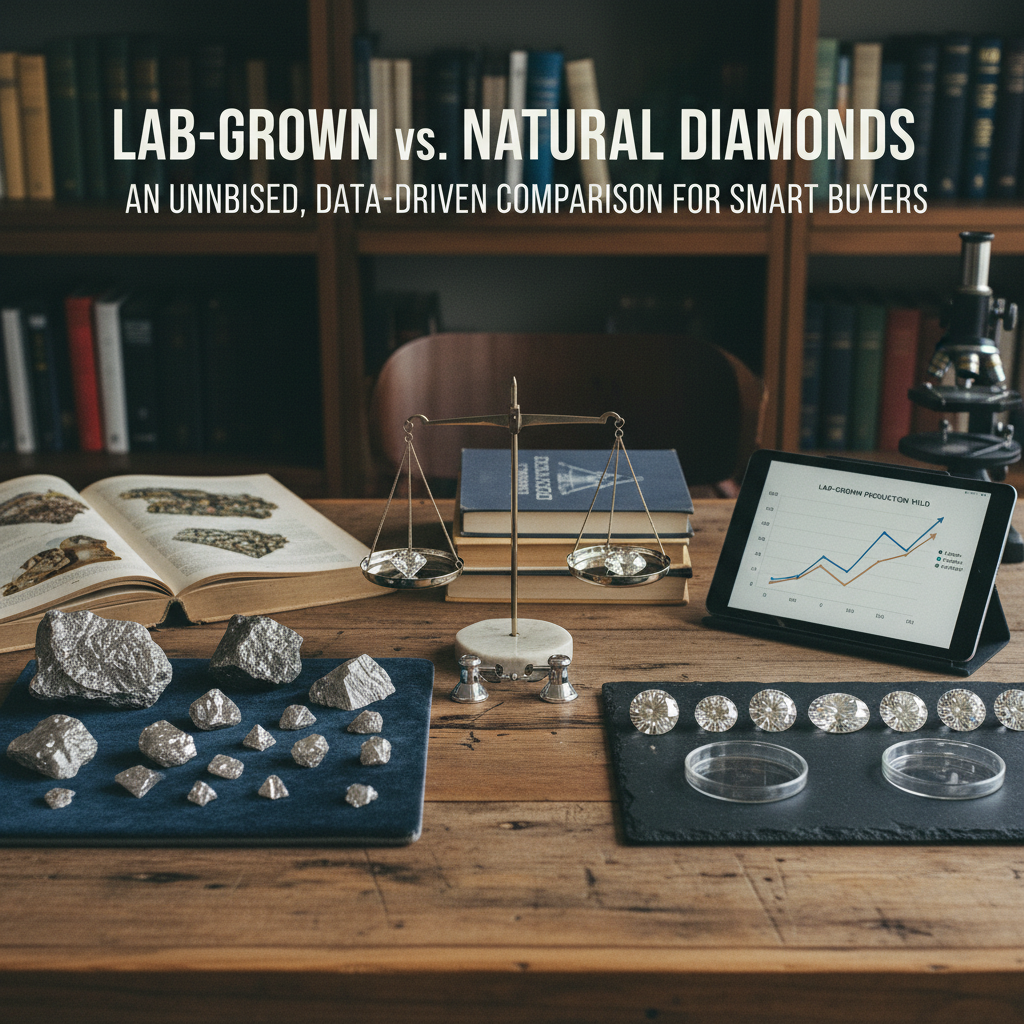
Lab-Grown vs. Natural Diamonds: An Unbiased, Data-Driven Comparison for Smart Buyers
Lab-grown and natural diamonds are chemically, physically, and visually identical forms of carbon, distinguished primarily by their origin—geological pressure versus plasma reactors—and their long-term market value. While lab-grown stones offer significant upfront affordability and ethical transparency, natural diamonds retain the allure of geological rarity and established resale potential. This guide provides a granular analysis of the trade-offs between tradition and technology to help you make an informed purchase.
[IMAGE: Split image showing a raw natural diamond in kimberlite rock on the left and a rough lab-grown diamond crystal in a plasma reactor on the right.]
The 30-Second Summary: Lab-Grown vs. Natural Diamonds Data Table
Before diving into the scientific and economic nuances, it is essential to understand the high-level differences. Both stones score a 10 on the Mohs scale and sparkle identically, yet their economic trajectories are polar opposites.
Quick Comparison: Origin, Price, Resale, and Durability
| Feature | Natural Diamond | Lab-Grown Diamond |
|---|---|---|
| Primary Origin | Mined from Earth (1-3 billion years old) | Created in a Lab (Weeks to Months) |
| Chemical Composition | Pure Carbon (C) | Pure Carbon (C) |
| Cost (1 Carat) | High (Premium pricing) | Low (~70-95% cheaper than natural) |
| Resale Value | Moderate (Retains ~50-70% of market value) | Negligible (Near zero resale value) |
| Durability | 10/10 Mohs Hardness | 10/10 Mohs Hardness |
| Visual Appearance | Indistinguishable to the naked eye | Indistinguishable to the naked eye |
| Rarity | Finite resource | Potentially infinite supply |
The ‘Is It Real?’ Verdict: Chemical Identity Explained
The most common misconception in the jewelry market is that lab-grown diamonds are “fake” or simulants like cubic zirconia. This is scientifically incorrect. To understand the value proposition, we must first validate the material identity of the stones.
Chemical Composition and Crystal Structure Breakdown
Both natural and lab-grown diamonds are composed of pure crystallized carbon arranged in an isometric cubic structure. This specific atomic arrangement gives diamonds their legendary hardness and refractive index (sparkle).
- Natural Diamonds: Formed deep within the Earth’s mantle under extreme heat and pressure over billions of years.
- Lab-Grown Diamonds: Created using High Pressure High Temperature (HPHT) or Chemical Vapor Deposition (CVD), replicating the Earth’s conditions to crystallize carbon seeds.
- The Result: Both stones share the same refractive index (2.42) and dispersion (0.044), meaning they handle light exactly the same way.
Can Jewelers Tell the Difference? (Visuals vs. Advanced Testing)
To the naked eye—and even under a standard jeweler’s loupe—lab-grown and natural diamonds are identical. A jeweler cannot distinguish them simply by looking at the sparkle.
- Standard Testers: Thermal conductivity probes used by most pawn shops will identify both as “Diamond.”
- Advanced Equipment: Gemological labs use specialized machines to detect trace elements. They look for specific growth patterns or the lack of nitrogen (common in lab stones), which are invisible without magnification and UV light analysis.
The Inclusion Factor: Metallic Flux vs. Natural Mineral Flaws
While they look the same, their “birthmarks” differ at a microscopic level. These internal flaws, or inclusions, tell the story of the stone’s creation.
- Natural Inclusions: Often contain tiny crystals of other minerals (garnet, olivine) or feathers caused by geological stress.
- Lab Inclusions:
- HPHT stones may contain trace amounts of metallic flux (iron, nickel) used during growth.
- CVD stones often show distinctive layering or “strain patterns” that serve as fingerprints for gemologists.
[IMAGE: Microscopic side-by-side comparison of a natural feather inclusion versus a metallic flux inclusion in a lab-grown diamond.]
Financial Deep Dive: Cost Analysis and Market Trends
The most compelling argument for lab-grown diamonds is price, while the strongest argument for natural diamonds is value retention. Understanding the economics of scarcity is vital for a smart purchase.
Current Price Comparison: 1 Carat to 3 Carat Pricing (Natural vs. Lab)
The price gap between natural and lab-grown diamonds widens significantly as carat weight increases. Because large natural diamonds are exponentially rarer, their price per carat jumps drastically. Lab diamonds, however, are priced based on manufacturing costs, which remain relatively linear.
- 1 Carat Round Brilliant: A high-quality lab diamond may cost $800–$1,000, while a comparable natural diamond commands $6,000–$8,000.
- 3 Carat Round Brilliant: The gap explodes. A lab stone might cost $3,000–$5,000, whereas a natural equivalent could easily exceed $40,000–$60,000.
The Economics of Scarcity: Why Natural Diamonds Command a Premium
Natural diamonds are a finite resource. No new diamonds are being created by the Earth in accessible locations, and many major mines (like the Argyle mine in Australia) have ceased operations. This supply cap supports a baseline value for natural stones.
Historical Data: The Precipitous Drop in Lab-Grown Prices (2016-Present)
Since 2016, the cost of producing lab-grown diamonds has plummeted due to technological efficiency and competition.
- 2016: Lab diamonds traded at roughly 10-20% less than natural.
- 2020: The discount widened to 50%.
- Today: Lab diamonds often trade at 80-95% less than natural diamonds.
- Future Outlook: As production capacity scales indefinitely, the wholesale price of lab-grown stones continues to trend downward, behaving more like technology hardware than precious commodities.
[GRAPH: Line graph showing the downward price trend of 1-carat lab-grown diamonds from 2016 to present compared to the relatively stable price of natural diamonds.]
Investment Reality: Resale Value and Asset Retention
Buying a diamond is an emotional expenditure, but understanding the exit strategy is crucial. The market treats these two identical-looking stones very differently on the secondary market.
The Hard Truth: Why Lab Diamonds Have Near-Zero Resale Value
Lab-grown diamonds should be viewed as a consumption expense, not an investment. Because the cost to manufacture them drops every year, the used market collapses. Jewelers and pawn shops generally do not buy back lab-grown diamonds because they can simply buy a brand new one from a manufacturer for less than a consumer paid a year ago.
Natural Diamonds as a Store of Value: Stability Over Time
Natural diamonds generally retain value, though they are not a “get rich quick” scheme. You can typically expect to recoup 50% to 70% of the retail price if you sell a high-quality natural stone. They act as a store of value against inflation over very long periods.
Context: Loose Diamonds vs Jewelry Diamonds Investment Potential
It is also vital to distinguish between the stone itself and the finished jewelry piece. A designer setting may hold value differently than the center stone. For a deeper understanding of how settings affect value and liquidity, read our guide on Loose Diamonds vs Jewelry Diamonds.
Environmental & Ethical Audit: Beyond the Marketing
Marketing campaigns often paint lab diamonds as “sustainable” and natural diamonds as “unethical.” The data reveals a much more complex reality involving energy grids and community support.
Mining vs. Manufacturing: Land Displacement vs. Energy Intensity
- Natural Diamonds: Mining requires moving massive amounts of earth (approx. 250 tons per carat). This disrupts local ecosystems and biodiversity.
- Lab-Grown Diamonds: Manufacturing is incredibly energy-intensive. Creating the plasma required to crystallize carbon requires massive electricity loads over weeks.
Carbon Footprint Data: Examining the ‘Eco-Friendly’ Claims and Greenwashing
The “eco-friendly” label depends entirely on the energy source.
- The Reality: A significant portion of lab diamonds are produced in countries like India and China, where the power grid is heavily reliant on coal. In these instances, the carbon footprint of a lab diamond can actually exceed that of a natural diamond.
- The Solution: Buyers seeking true sustainability must look for “Certified Sustainability Rated” diamonds produced with 100% renewable energy (hydro or solar).
Human Rights: The Kimberley Process vs. Factory Conditions
- Natural: The Kimberley Process has reduced conflict diamonds to <1% of the market. Furthermore, mining supports millions of livelihoods in Botswana, Canada, and Namibia, often providing infrastructure and education.
- Lab-Grown: While free from conflict zone concerns, the industry is not immune to poor labor practices in mass-production factories.
Durability Check: The Mohs Scale Comparison
For daily wear, particularly engagement rings, durability is non-negotiable. Fortunately, physics favors both options equally.
Scratch Resistance and Daily Wear Longevity
Both stones rank a 10 on the Mohs Scale of Mineral Hardness. This makes them the hardest known materials on Earth.
- Everyday Wear: Neither stone will scratch or cloud over time (unlike cubic zirconia or moissanite).
- Heirloom Potential: Both stones are durable enough to be passed down through generations without showing signs of wear.
Heat Sensitivity and Care Requirements
Both natural and lab diamonds are excellent thermal conductors. They can withstand the heat of a jeweler’s torch during resizing or repair. Cleaning methods—ultrasonic baths and steam cleaning—are safe for both varieties.
The Smart Buyer’s Decision Matrix: Pros and Cons
Choosing between natural and lab-grown is not about right or wrong; it is about aligning the purchase with your financial goals and personal values.
Checklist: When to Choose Lab-Grown (Maximizing Budget, Specific Shapes, Modern Ethics)
- Budget is Priority: You want the biggest, highest-quality look for your money.
- Fancy Shapes: You want a large oval, pear, or emerald cut, which are exorbitantly expensive in natural form.
- Scientific Appreciation: You appreciate the technological marvel of creating a diamond.
- No Resale Concern: You do not intend to sell the ring and view it purely as a gift or accessory.
Checklist: When to Choose Natural (Heirloom Status, Romance, Long-Term Value)
- Tradition: You value the romance of a stone created by the Earth billions of years ago.
- Asset Value: You want the security of knowing the item retains residual monetary value.
- Uniqueness: You prefer owning something rare and finite rather than mass-produced.
- Status: You prefer the prestige associated with natural gemstones.
Conclusion: Balancing Emotion and Economics
The “Great Diamond Divide” ultimately comes down to a trade-off between upfront cost and backend value. If you want to maximize carat size and clarity for a specific budget today, lab-grown diamonds are the undeniable mathematical winner. However, if you view jewelry as a store of generational wealth and value the mystique of geological rarity, natural diamonds remain the gold standard.
Smart buyers analyze the data, ignore the fear-mongering from both sides, and choose the stone that fits their financial roadmap and romantic narrative.
FAQ: Common Questions About Lab and Natural Diamonds
- Q: Do lab-grown diamonds turn yellow over time?*
A: No. Lab-grown diamonds are pure carbon, just like natural diamonds. They do not fade, cloud, or change color over time.
- Q: Can I insure a lab-grown diamond?*
A: Yes. Insurance companies treat lab-grown diamonds exactly like natural ones. You will pay a premium based on the replacement value of the stone.
- Q: Are lab diamonds considered “fake”?*
A: No. They are “real” diamonds in every chemical and physical sense. The Federal Trade Commission (FTC) classifies them as diamonds.
- Q: Why do some jewelers refuse to sell lab-grown diamonds?*
A: Many luxury jewelers avoid them due to the crashing wholesale prices, which makes inventory management risky and reduces their profit margins compared to natural stones.
This reluctance among high-end retailers highlights a significant challenge for lab-grown diamonds to penetrate the luxury market segment effectively. Despite their identical chemical composition, the perceived value and economic stability of natural diamonds continue to give them an advantage for jewelers focused on high-margin sales and investment pieces.