
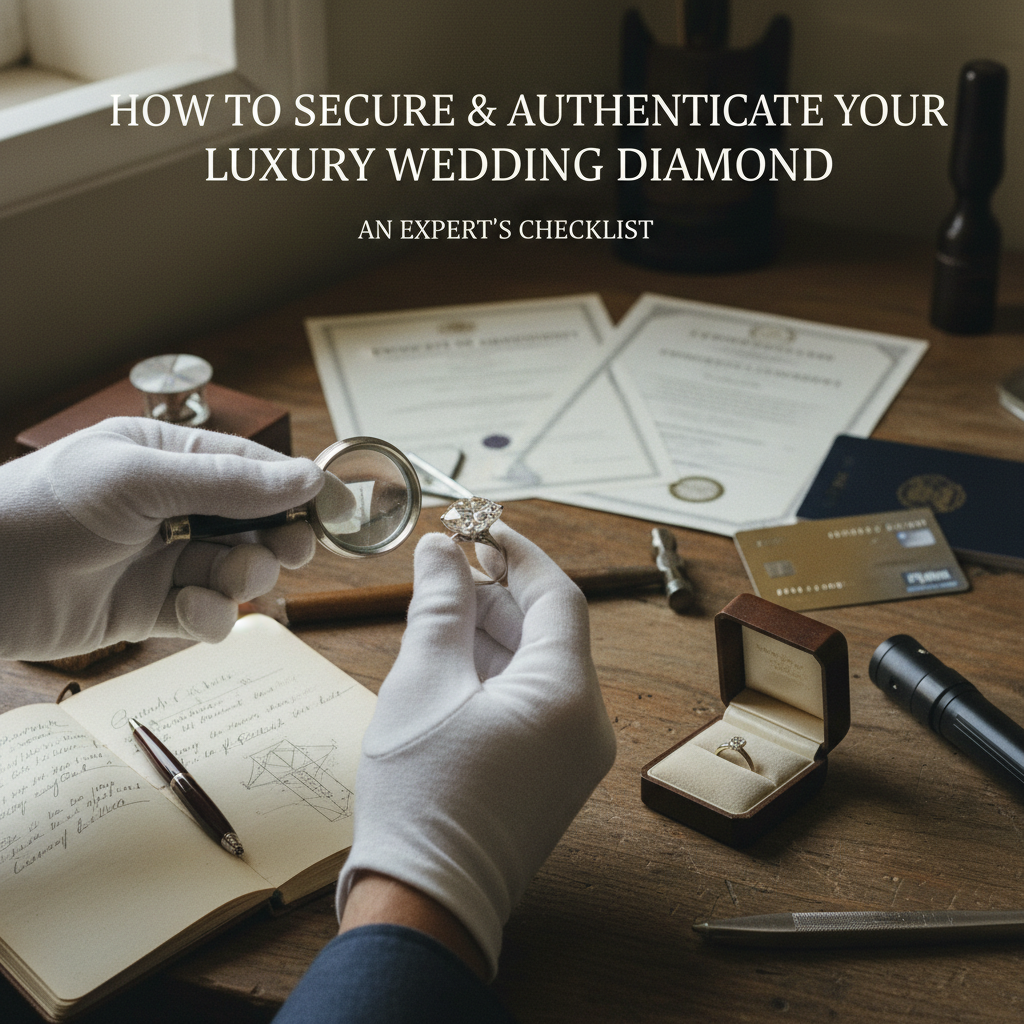
Securing and authenticating a high-value wedding diamond requires a multi-layered protocol involving independent GIA verification to establish provenance, hardened physical storage (utilizing TL-15 rated safes or bank deposit boxes), and specialized jewelry insurance based on “Agreed Value.” This comprehensive guide details the specific operational security measures experts use to protect luxury stones from fraud, theft, loss, and damage, ensuring your investment remains safe from the moment of purchase through decades of wear.
[IMAGE: A close-up, high-resolution shot of a diamond engagement ring being inspected under a jeweler’s loupe, with a GIA certificate blurred in the background.]
The 3-Pillars Protocol: Direct Answer to Securing High-Value Diamonds
When dealing with significant assets, relying on luck is not a strategy. Security experts and gemologists rely on a “Triad of Protection” to safeguard high-net-worth jewelry. This protocol ensures that even if one layer fails, the others remain intact to preserve the asset’s value.
For those investing in Luxury Diamonds, adhering to these three pillars is non-negotiable. Neglecting one exposes the asset to significant risk, whether that be purchasing a fraudulent stone, losing it to a burglary, or suffering a financial loss due to inadequate insurance coverage.
Authentication: Establishing the Baseline
Before security can be applied, value must be verified. This involves scientific grading by a third-party laboratory (preferably GIA or AGS) and verifying the stone’s physical identity against its report using laser inscriptions. If you cannot prove what you have, you cannot protect it.
Physical Security: Hardening the Target
This pillar involves the tangible barriers placed between the diamond and a potential thief. It moves beyond the standard “hide it in a drawer” mentality to professional-grade containment, such as TL-rated safes, and strict operational security (OpSec) regarding who knows about the jewelry and where it is kept.
Financial Protection: Risk Transfer
The final pillar is the financial safety net. When physical security fails, financial instruments must trigger immediate restitution. This requires moving away from standard homeowners policies toward specialized “All-Risk” coverage that accounts for the full replacement cost of luxury goods without depreciation.
Key Takeaways: The Expert’s Quick Guide
- Verify Identity: Never rely on a seller’s word; match the physical diamond’s laser inscription to its GIA report number using a microscope.
- Avoid DIY Tests: Fog and water tests are unreliable for high-value stones; stick to thermal conductivity testers and professional lab grading.
- Hardened Storage: Standard fire safes yield to tools in minutes; use a TL-15 or TL-30 rated safe for home storage of high-value items.
- Insurance Nuance: Opt for “Agreed Value” policies over “Actual Cash Value” to prevent losing money to market depreciation during a claim.
- Maintenance OpSec: Use the “Looping” technique (inspecting the stone under magnification) before and immediately after leaving a repair shop to prevent stone swapping.
Step 1: Authenticating a Loose Diamond or Engagement Ring
Authenticating a diamond is the process of confirming that the stone matches the quality claims made by the seller and belongs to the specific grading report provided. For high-value wedding diamonds, this is a scientific process that leaves no room for ambiguity.
[IMAGE: A side-by-side comparison graphic. On the left, a “fog test” on a diamond. On the right, a digital microscope image showing a laser inscription number.]
Why DIY Fog and Water Tests Are Risky for High-Value Goods
The internet is full of “hacks” like breathing on a diamond to see if it fogs up or dropping it in water to test density. Do not rely on these. High-quality synthetic moissanite can often pass a heat conductivity test, and white sapphire can behave similarly in water. When thousands of dollars are at stake, relying on subjective “kitchen table” physics is reckless. Professional verification requires magnification and refractive index measurement.
The Gold Standard: Understanding GIA Certificates for Luxury Wedding Rings
The Gemological Institute of America (GIA) sets the global standard for diamond grading. A GIA report is not just a receipt; it is a blueprint of your diamond’s DNA. It maps the inclusions (internal flaws) and blemishes (external flaws). For security, this plot is vital—it proves that a specific stone is yours because no two diamonds have the exact same inclusion map.
Verifying Laser Inscriptions: The Diamond’s Fingerprint
Most modern GIA-graded diamonds have a microscopic laser inscription on the girdle (the outer edge) of the stone. This inscription matches the report number.
- The Check: Ask your jeweler to show you this number under a gemological microscope or a high-powered loupe (10x minimum, 20x preferred).
- The Match: Verify digit-for-digit that the number on the stone matches the paper report. This is the ultimate proof of identity.
Independent Appraisals vs. Lab Grading Reports
Do not confuse an appraisal with a grading report. A grading report (GIA/AGS) defines the quality (Carat, Color, Clarity, Cut). An appraisal assigns a monetary value for insurance purposes. You need the grading report first to ensure the appraisal is accurate. Always use an independent appraiser who is not affiliated with the seller to get an unbiased valuation.
Step 2: Safest Ways to Store High-Value Diamond Jewelry
Storage is about delaying and discouraging theft. Most residential burglaries are “smash and grab” operations lasting less than ten minutes. Your goal is to make the diamond inaccessible within that timeframe.
[IMAGE: A heavy steel safe installed inside a wall, hidden behind a large painting or mirror.]
Home Safe vs. Bank Safe Deposit Box: A Security Comparison
A bank safe deposit box offers the highest security but lowest accessibility. It is ideal for heirlooms worn rarely. For a wedding diamond worn daily or weekly, a home safe is practical. However, the majority of home safes sold at big-box stores are fire safes, not burglary safes. They can be pried open with a crowbar in under two minutes.
Understanding TL-15 and TL-30 Safe Ratings for Home Use
If you store luxury diamonds at home, ignore “UL RSC” (Residential Security Container) ratings. Look for TL ratings:
- TL-15: The safe door successfully resisted entry by expert safecrackers using hand tools and electric tools for a net working time of 15 minutes.
- TL-30: Same parameters, but resisted for 30 minutes.
These safes are heavy, expensive, and usually require professional installation (bolting to concrete). They are the only responsible choice for high-value jewelry storage at home.
Concealment Strategies and Decoy Safes
Security through obscurity is a valid layer when combined with physical hardening.
- Decoy Safe: Place a cheap, visible safe in the master closet containing a small amount of cash and costume jewelry. Thieves will grab this and leave.
- True Location: Install the TL-rated safe in a utility room, basement, or guest bedroom closet—areas thieves rarely prioritize during quick hits.
Step 3: Financial Safety Nets and Insurance
Even the best physical security can be breached by a determined professional or a natural disaster. Insurance is your final firewall. However, standard policies rarely cover the full value of a luxury diamond.
[IMAGE: A close-up of an insurance policy document with the words “Agreed Value” highlighted in yellow marker.]
Do I Need Separate Insurance for My Wedding Diamond?
Yes. Standard homeowners or renters insurance usually places a “cap” on jewelry coverage, often as low as $1,500 to $2,500 total. If your ring is worth $20,000, a standard claim would result in a massive financial loss. You require a policy specifically designed for high-value items.
Homeowners Riders vs. Dedicated Jewelry Policies
You can add a “rider” or “floater” to your home insurance, but a dedicated jewelry policy (like Jewelers Mutual) is often superior. Dedicated policies typically cover “mysterious disappearance” (you lost it, it wasn’t stolen), whereas riders often require proof of theft. Furthermore, a claim on a dedicated policy won’t increase your home insurance premiums.
Agreed Value vs. Actual Cash Value: A Critical Distinction
This is the most important term in your contract.
- Actual Cash Value (ACV): The insurer pays what the ring is worth today (used market price). This is almost always less than what you paid.
- Agreed Value: The insurer pays the specific amount listed on the appraisal, regardless of current market fluctuations. Always insist on Agreed Value for luxury diamonds.
Data Breakdown: Average Insurance Premiums for Luxury Diamonds
Below is a comparison of insurance structures for a diamond ring appraised at $20,000.
| Insurance Type | Coverage Scope | Valuation Method | Approx. Annual Cost | Deductible Impact |
|---|---|---|---|---|
| Homeowners Rider | Limited (Theft/Fire) | Often ACV | $100 – $300 | Tied to Home Policy |
| Dedicated Policy | All-Risk (Includes Loss/Damage) | Agreed Value | $200 – $400 | Flexible ($0 – $1k) |
| Warranty | Defect Repair Only | N/A | Included with Purchase | N/A |
- Note: Premiums vary by zip code and storage security measures.*
Step 4: Operational Security During Travel and Maintenance
Your diamond is most vulnerable when it is outside your home. Implementing strict behavioral protocols reduces the risk of opportunistic theft.
[IMAGE: A woman wearing a ring turning the stone inward towards her palm (palming the ring) while walking through a crowded street.]
How to Prevent Diamond Theft While Traveling With Jewelry
- In-Transit: Never put jewelry in checked luggage. Keep it on your person or in a bag that never leaves your sight.
- Hotels: Room safes are not secure; hotel staff often have override codes. Use the hotel’s main vault at the front desk for high-value items, or keep the item worn.
- airports: Do not take your ring off at TSA checkpoints and put it in the plastic bin. You are legally allowed to wear fine jewelry through the scanner. If searched, request a private screening.
The ‘Looping’ Technique: Avoiding Stone Swapping During Repairs
Stone swapping (replacing a diamond with a simulant or lower-quality stone) is rare but possible during repairs or cleaning.
- The Protocol: Before handing your ring to a jeweler, ask them to “Loop” (inspect) the laser inscription with you present. Write the number down on the take-in receipt.
- Verification: Upon pick-up, do not leave the counter until you have Looped the stone again and verified the inscription matches the receipt.
Visual Inspections: How to Tell if a Diamond is Loose in the Setting
A loose diamond is a lost diamond waiting to happen. Perform this simple test monthly:
- The Tap Test: Hold the ring near your ear and tap the band. A rattling sound indicates the stone is loose.
- The Tweezer Check: Gently push the stone with a tweezer or fingernail. If it shifts or rotates, stop wearing it immediately and seek professional repair.
The Ultimate Expert Checklist for Securing and Authenticating Wedding Diamonds
Use this checklist to ensure complete coverage of your asset.
Pre-Purchase Authentication Steps
- [ ] Request the GIA or AGS grading report prior to payment.
- [ ] Verify the report number on the GIA online report check database.
- [ ] Confirm the return policy allows for independent verification.
Post-Purchase Security Hardening
- [ ] Verify the laser inscription matches the report using a loupe.
- [ ] Obtain an independent appraisal for “Retail Replacement Value.”
- [ ] Purchase a dedicated “Agreed Value” insurance policy.
- [ ] Install a TL-15 or disguised safe (if not using a bank box).
Annual Maintenance Protocol
- [ ] Professional prong inspection and tightening.
- [ ] Steam cleaning to remove grime that masks brilliance.
- [ ] Update appraisal every 3–5 years to account for inflation and diamond market shifts.
Conclusion: Preserving Your Legacy and Luxury Diamonds
A high-value wedding diamond is more than a financial asset; it is a physical embodiment of a relationship and a future heirloom. By treating it with the same security rigor as a financial portfolio—authenticating its origin, hardening its storage, and insuring its value—you ensure that this symbol of luxury remains in your family for generations. Vigilance is the price of ownership, but peace of mind is the reward.