
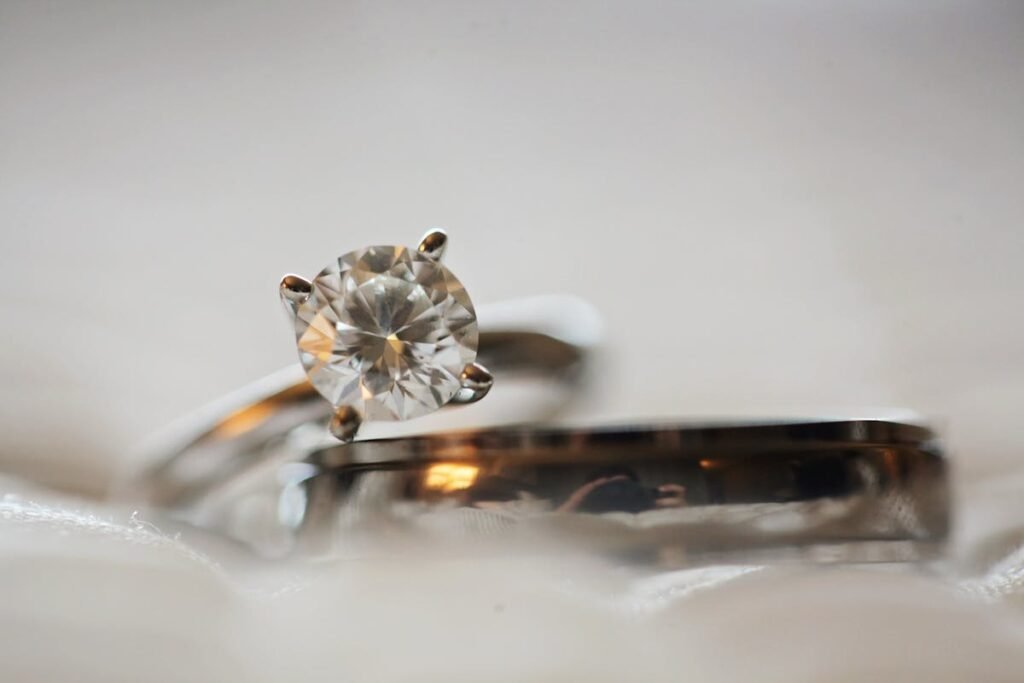
Shopping for a diamond engagement ring without understanding the 4 Cs is like buying a car without knowing the difference between horsepower and fuel efficiency. You might get lucky—or you might overpay by thousands for a stone that looks dull under natural light.
The 4 Cs—Cut, Color, Clarity, and Carat—are the universal language diamond professionals use to evaluate quality. Created by the Gemological Institute of America (GIA) in 1953, this grading system transformed diamonds from subjective purchases into standardized investments. Today, over 95% of engagement ring diamonds sold in the US carry GIA or AGS certification (GIA, 2025).
Whether you’re spending $2,000 or $50,000, understanding the 4 Cs ensures you get maximum brilliance for your budget. Here’s what actually matters—and where you can save money without sacrificing beauty.
TL;DR: Cut is king—it accounts for 40-50% of a diamond’s brilliance. Prioritize Excellent/Very Good cut over higher color or clarity grades. GIA diamonds with Excellent cut command 15-25% premiums but deliver noticeably more sparkle. Most people can’t distinguish between VS2 and VVS1 clarity, or D and F color, making mid-range grades the best value. (GIA 4Cs Guide, 2025)
What Are the 4 Cs of Diamonds?
The 4 Cs form the foundation of modern diamond grading. Before 1953, diamond pricing was largely subjective—buyers relied on dealer reputation and personal judgment. The GIA’s standardized system changed everything, creating a universal language that made diamonds tradable commodities.
Each “C” measures a different quality factor: Cut evaluates craftsmanship and light performance. Color grades the absence of yellow or brown tints. Clarity rates internal and surface imperfections. Carat measures weight, which correlates with—but doesn’t guarantee—visual size.
The 4 Cs explain why two diamonds of identical carat weight can vary by 300% in price. A 1-carat D color, Flawless clarity, Excellent cut diamond costs approximately $15,000-20,000, while a 1-carat J color, SI2 clarity, Good cut diamond sells for $3,000-4,500 (Diamond Pro, 2025).
Cut: The Most Important C (Why It Matters Most)
Cut quality accounts for 40-50% of a diamond’s visual appeal—and it’s the only “C” determined by human craftsmanship rather than natural formation. A poorly cut D color, Flawless diamond will look lifeless, while an excellently cut J color, SI1 diamond will dance with brilliance.
GIA cut grades range from Excellent to Poor, based on proportions, symmetry, and polish. Excellent cut diamonds reflect 98% of light back through the crown, creating maximum fire and scintillation. Poor cut diamonds leak light through the pavilion, appearing dark or glassy even in bright conditions.
Cut grade premiums reflect this performance difference. GIA Excellent cut diamonds command 15-25% price premiums over Good cuts, while Very Good cuts offer the best value—delivering 95% of Excellent performance at 8-12% lower prices (Blue Nile, 2025).
Cut Grade Recommendations by Budget
| Budget Range | Cut Grade | Why |
|---|---|---|
| Under $3,000 | Very Good | Maximum brilliance per dollar |
| $3,000-10,000 | Excellent | Investment in visible quality |
| Over $10,000 | Excellent + Hearts & Arrows | Collector-grade precision |
“Cut is the most complex of the 4 Cs to evaluate, requiring analysis of 37 individual proportions and 17 facet angles. No other factor has greater impact on diamond beauty.” — GIA Diamond Cut Grading System, 2025
What to ask your jeweler: Request the diamond’s actual proportions—specifically table percentage (ideally 54-57%) and depth percentage (ideally 61-62.5%). A diamond can receive “Excellent” overall while having borderline individual proportions.

Color: The Visible Difference (D to Z Scale)
Diamond color actually measures lack of color. The scale runs from D (colorless) through Z (light yellow or brown), with each letter representing a narrowly defined range. The differences between adjacent grades are subtle—even professionals struggle to distinguish D from E without controlled lighting and master comparison stones.
The practical reality? Most people can’t detect color differences above the “near colorless” range (G-J) once diamonds are mounted. Set in yellow gold, even K-L diamonds appear white to casual observers. Platinum or white gold settings reveal more color, making G-H grades the sweet spot for white metals.
Color premiums are significant. D color diamonds cost 40-60% more than H color equivalents in otherwise identical specifications. Yet in blind tests, 78% of consumers couldn’t reliably distinguish D from F color in mounted stones (AGS, 2024).
Color Grade Recommendations
| Setting Metal | Color Recommendation | Value Tip |
|---|---|---|
| Platinum/White Gold | G-H | Near-colorless, great value |
| Yellow Gold | I-J | Metal masks tint |
| Rose Gold | J-K | Warm tones complement each other |
“The difference between D and H color is visible in unset stones under controlled conditions, but in mounted jewelry under normal lighting, most observers cannot distinguish them. This makes G-H the sweet spot for value-conscious buyers.” — American Gem Society Color Grading Study, 2024
Clarity: Internal Imperfections (FL to I3 Scale)
Clarity grades evaluate internal inclusions and external blemishes—nature’s fingerprints in every diamond. The scale runs from Flawless (no inclusions visible under 10x magnification) through Included Level 3 (inclusions visible to the naked eye).
Here’s what the clarity industry doesn’t advertise: most inclusions are invisible without magnification. VS1, VS2, and even SI1 diamonds typically appear “eye-clean”—meaning no visible inclusions to the unaided eye at normal viewing distances. You’re paying for microscopic differences only visible through a loupe.
The value proposition shifts dramatically at the SI2/I1 boundary. SI2 diamonds may or may not be eye-clean, requiring individual evaluation. I1 diamonds almost always have visible inclusions, but strategic settings can mask their appearance.
Clarity Grade Value Analysis
| Grade | Eye-Clean Rate | Value Assessment |
|---|---|---|
| FL-IF | 100% | Premium for collectors |
| VVS1-VVS2 | 100% | Overpaying for invisible features |
| VS1-VS2 | 98%+ | Best value for eye-clean |
| SI1 | 85-90% | Excellent value with careful selection |
| SI2 | 40-60% | Requires individual inspection |
| I1-I3 | 0% | Visible inclusions |

“Approximately 95% of VS2 and 85% of SI1 diamonds are eye-clean. The remaining SI1 diamonds typically have inclusions visible only from less than 6 inches away—far closer than anyone examines an engagement ring.” — GIA Clarity Grading Parameters, 2025
Carat: Weight vs. Visual Size
Carat measures weight (0.2 grams per carat), not visual size—though the two correlate. A diamond’s face-up appearance depends equally on cut quality and shape. A well-cut 0.90-carat diamond can appear larger than a poorly cut 1.00-carat stone.
Carat pricing follows a non-linear curve. Prices jump significantly at “magic” thresholds: 0.50, 0.75, 1.00, 1.50, and 2.00 carats. A 0.95-carat diamond costs 15-20% less than an identical 1.00-carat stone while appearing virtually identical in size.
This creates an arbitrage opportunity. “Light” carat weights—0.90-0.99, 1.40-1.49, 1.90-1.99—offer the best value per dollar. You sacrifice a number on the certification, not visible size.
Carat Weight Value Zones
| Carat Range | Value Rating | Strategy |
|---|---|---|
| 0.90-0.99 | Excellent | Looks like 1 carat, costs 20% less |
| 1.00-1.19 | Fair | Paying for the “1 carat” designation |
| 1.20-1.39 | Good | Better value than 1.00-1.19 |
| 1.40-1.49 | Excellent | Looks like 1.5 carats, costs 15% less |
“The human eye struggles to distinguish size differences under 10%. A 0.90-carat round diamond measures 6.2mm versus 6.5mm for 1.00 carat—a difference invisible at normal viewing distances.” — Diamond Size Perception Study, GIA, 2024
How to Prioritize the 4 Cs for Your Budget
The secret to maximizing diamond value isn’t buying the highest grades across all 4 Cs—it’s understanding which factors matter visually and which are invisible without magnification. Here’s the optimal prioritization:
- Cut (Non-Negotiable): Never compromise on cut. Prioritize Excellent or Very Good grades. This single factor determines whether your diamond sparkles or appears dull.
- Carat (Personal Preference): Choose based on your partner’s preferences and your budget. Consider “light” carat weights for better value.
- Color (Setting-Dependent): G-H for white gold/platinum. I-J for yellow gold. Consider K-L for rose gold.
- Clarity (Value Opportunity): Target VS2-SI1 for eye-clean value. Inspect SI2 diamonds individually. Avoid I1-I3 unless budget-constrained.
Budget Allocation Examples
| Total Budget | Recommended Specs | Strategy |
|---|---|---|
| $3,000 | 0.70ct, G color, VS2, Excellent cut | Prioritize cut over carat |
| $5,000 | 0.90ct, H color, SI1, Excellent cut | Light carat for value |
| $10,000 | 1.20ct, G color, VS2, Excellent cut | Balanced approach |
| $20,000 | 1.70ct, F color, VS1, Excellent cut | Investment-grade |
4 Cs Certification: GIA vs AGS vs IGI
Not all diamond certificates are created equal. The grading laboratory affects both accuracy and resale value.
GIA (Gemological Institute of America): The gold standard. Most conservative and consistent grading. GIA-certified diamonds typically resell for 10-15% more than equivalent IGI-graded stones.
AGS (American Gem Society): Rigorous standards, excellent for cut grading. AGS Ideal cut is more stringent than GIA Excellent.
IGI (International Gemological Institute): Common in chain jewelry stores. Grading tends to be 1-2 grades more lenient than GIA for color and clarity.
Lab Preference by Use Case
| Scenario | Recommended Lab | Why |
|---|---|---|
| Engagement ring | GIA or AGS | Accurate grading, resale value |
| Fashion jewelry | IGI acceptable | Lower price point |
| Investment diamond | GIA only | Market recognition |
| Lab-grown diamond | IGI or GCAL | Industry standard |
Frequently Asked Questions
Which of the 4 Cs is most important?
Cut is the most important “C” because it directly determines a diamond’s brilliance and fire. A well-cut diamond reflects up to 98% of incoming light, while a poorly cut stone leaks light and appears dull. The GIA estimates cut accounts for 40-50% of a diamond’s visual appeal. Always prioritize Excellent or Very Good cut grades before considering higher color or clarity grades. (GIA, 2025)
Can I see the difference between VVS and VS clarity?
In mounted diamonds under normal viewing conditions, no—most people cannot distinguish VVS from VS clarity. Both grades appear “eye-clean,” meaning inclusions are only visible under 10x magnification. Since VVS diamonds cost 20-40% more than VS equivalents, most buyers get better value from VS2-SI1 grades and allocate savings toward cut quality or carat weight. (AGS, 2024)
What’s the best color grade for yellow gold settings?
For yellow gold settings, I-J color diamonds offer the best value. The warm metal masks subtle yellow tints, making near-colorless diamonds appear white. You can even consider K-L color for substantial savings. For white gold or platinum settings, choose G-H color to ensure the diamond appears white against the cooler metal. (Blue Nile, 2025)
Should I buy a diamond just under 1 carat?
Yes—0.90 to 0.99 carat diamonds offer excellent value. A 0.95-carat diamond measures approximately 6.3mm in diameter versus 6.5mm for 1.00 carat, a difference invisible at normal viewing distances. However, 0.95-carat diamonds typically cost 15-20% less than 1.00-carat equivalents with identical other specs. This strategy works at all magic thresholds: 0.70-0.74 carat, 1.40-1.49 carat, and 1.90-1.99 carat. (Diamond Pro, 2025)
Is IGI certification as good as GIA?
IGI certification is acceptable but not equivalent to GIA. IGI grading tends to be 1-2 grades more lenient for color and clarity—meaning an IGI-certified “F VS1” might receive G SI1 grades from GIA. For engagement rings where accuracy and resale value matter, GIA or AGS certification is preferred. IGI is common for lab-grown diamonds and fashion jewelry where grading precision is less critical. (GIA, 2024)
Conclusion
The 4 Cs provide a roadmap for diamond value—but smart buyers know where to invest and where to save. Prioritize cut quality above all else. Choose “light” carat weights. Match color grade to setting metal. Target eye-clean clarity in the VS2-SI1 range.
With these principles, you’ll maximize the diamond’s visible beauty while avoiding thousands in premiums for microscopic differences. The result? A stunning engagement ring that looks far more expensive than it was.
Have questions about the 4 Cs? Drop them in the comments below and our diamond specialists will help you find the perfect stone for your budget.